Whatcom County · WA
Tree Service in Whatcom County, WA
In most of Washington the wind that breaks trees comes off the ocean; in Whatcom County a good share of it drains down out of the Fraser Valley from the northeast, and plenty of what fails here fails for that reason. We drive up from Kelso for the planned end of the work — clearing, runs of removals, crane days and written assessments.
- Based in Kelso, WA
- Planned & larger-scope work
- Licensed & Insured
Most of Washington gets its damaging wind off the Pacific, out of the southwest. Whatcom County is the exception, and once you know that, a good deal of the tree failure between Bellingham and the border stops looking random.
The Fraser Outflow Loads Trees Backwards
The Fraser River cuts a gap through the Coast Mountains, and when cold continental air pools in the interior of British Columbia it drains out through that gap and fans southwest across Sumas, Nooksack, Lynden, Everson, Ferndale and Bellingham. It is cold, it is dry, it comes in hard bursts, and it blows from the northeast — the opposite of the direction these trees spent their lives bracing against.
Trees lay down reaction wood and put root mass where the load usually is. A Douglas fir well anchored against a February southwesterly can be poorly anchored against an outflow event, which is why conifers in the north county sometimes fail in a direction that looks wrong. Add the freezing rain that often rides the same weather pattern, loading the windward side of a crown with ice, and you get whole-tree failures on trees with no visible defect at all.
Three Rooting Environments Inside Forty Minutes
Across the north and central lowland the subsoil is glaciomarine drift — a dense grey clay left when the ice sheet retreated into salt water. Roots reach it and stop, so root plates run wide and shallow, and the ground stays cold and wet well into spring. That combination is the recipe for a windthrow, and it is why saturated soil plus an outflow event is worse than either alone.
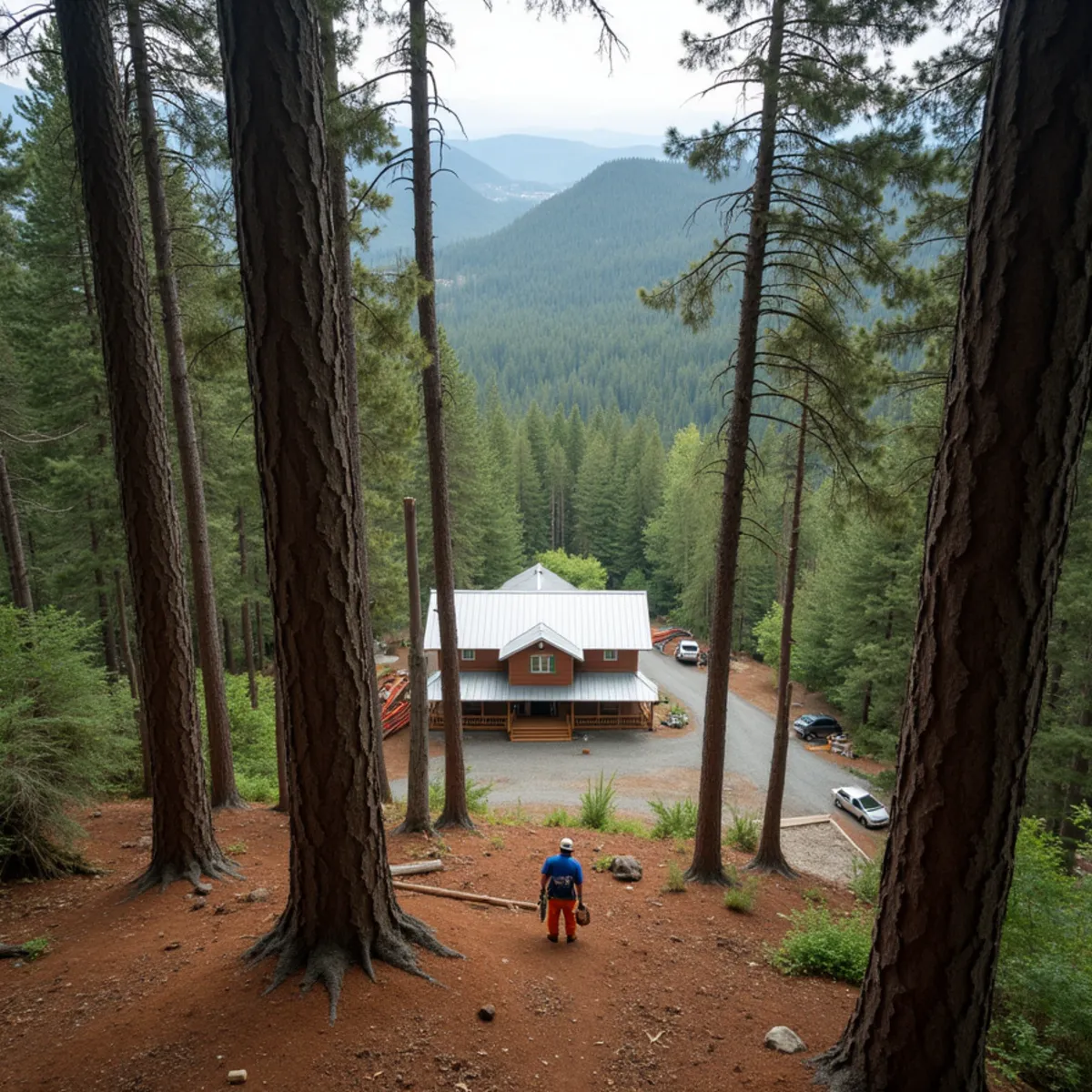
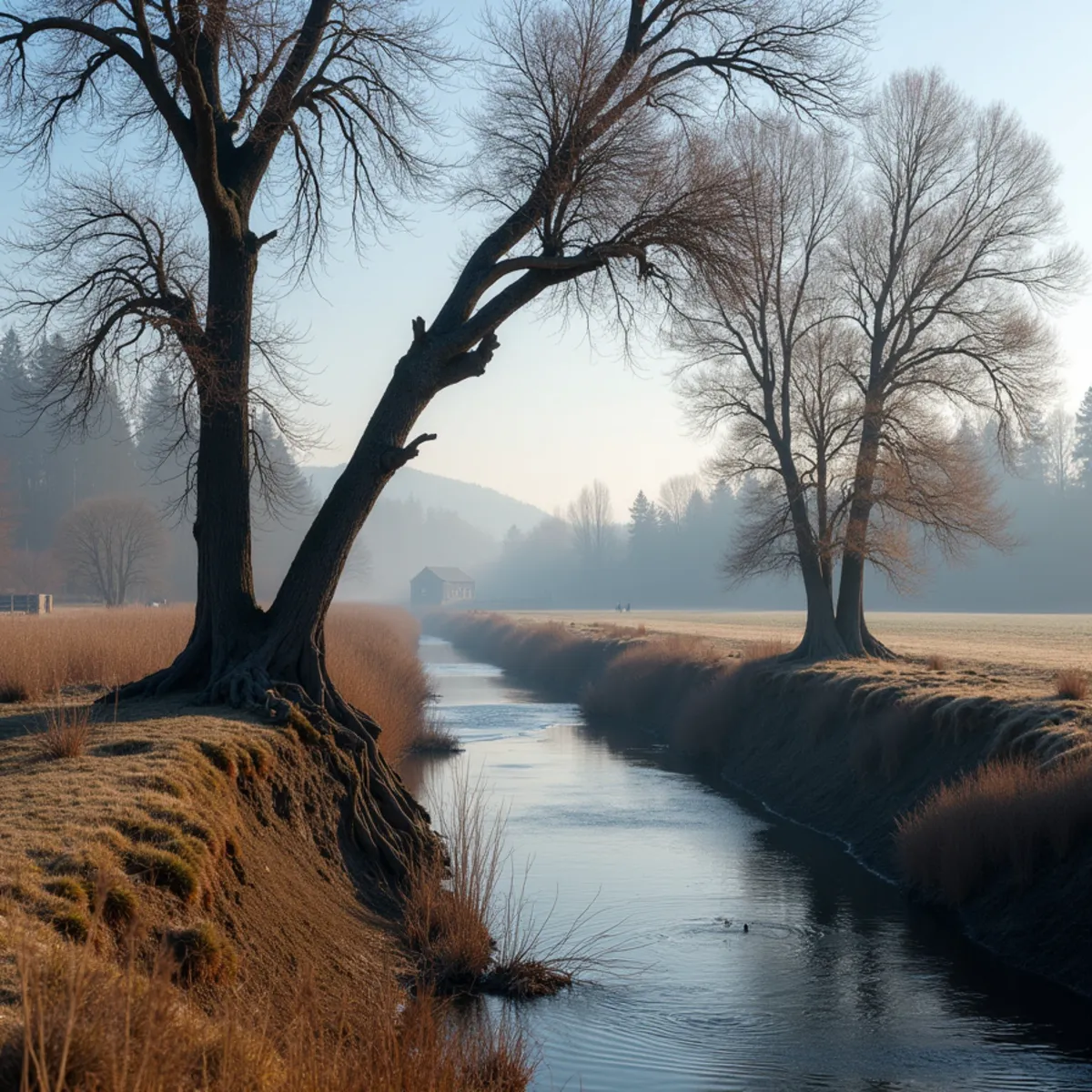
South of Bellingham the Chuckanut hills are sandstone under thin soil, dropping steeply toward the water. Trees there are rooted in fractures more than in dirt, and a removal is usually an access and rigging problem before it is a cutting problem. Then there is the Nooksack itself, whose gravel and silt floodplain grows tall, fast, brittle black cottonwood that the river undercuts every time it shifts a bend.
Farm Ground Trees Are Not Town Trees
Between Lynden, Everson and Ferndale the country is dairy pasture, raspberry and blueberry field, and the trees out there are functional: shelter rows, ditch-bank cottonwood and alder, big yard firs standing over century-old farmhouses. They fail into equipment sheds, fence line, irrigation mains and animal housing rather than into bedrooms, and they have to come out on the farm calendar, in the gap between field operations.
- Shelter-row and ditch-line clearing on working dairy and berry ground
- Multi-tree removals around farmsteads, barns and outbuildings
- Crane-assisted removals on tight Bellingham lots and Chuckanut slopes
- Commercial, HOA and property-management contracts covering several sites at once
- Written risk assessments where a removal decision has to be documented
Where to Go Next in Whatcom County
Bellingham, Ferndale, Lynden, Blaine, Everson and the foothill communities out toward Mount Baker each have a different species mix, a different soil under them and different access. Pick yours below for the local detail.
Cities & Communities We Cover in Whatcom County
What We Take On in Whatcom County
Have a larger job in Whatcom County?
Whatcom County Questions
Tree Care Reading
Guides Worth a Look
Free On-Site Estimates
Planning larger tree work in Whatcom County?
Call and describe the scope. We are based in Kelso — if a closer company serves you better, we will tell you.
- 34 Google reviews
- Licensed & Insured
- Free On-Site Estimates
- Based in Kelso, WA