Ice Storm Tree Damage in Camas and Washougal: Winter Prep That Works
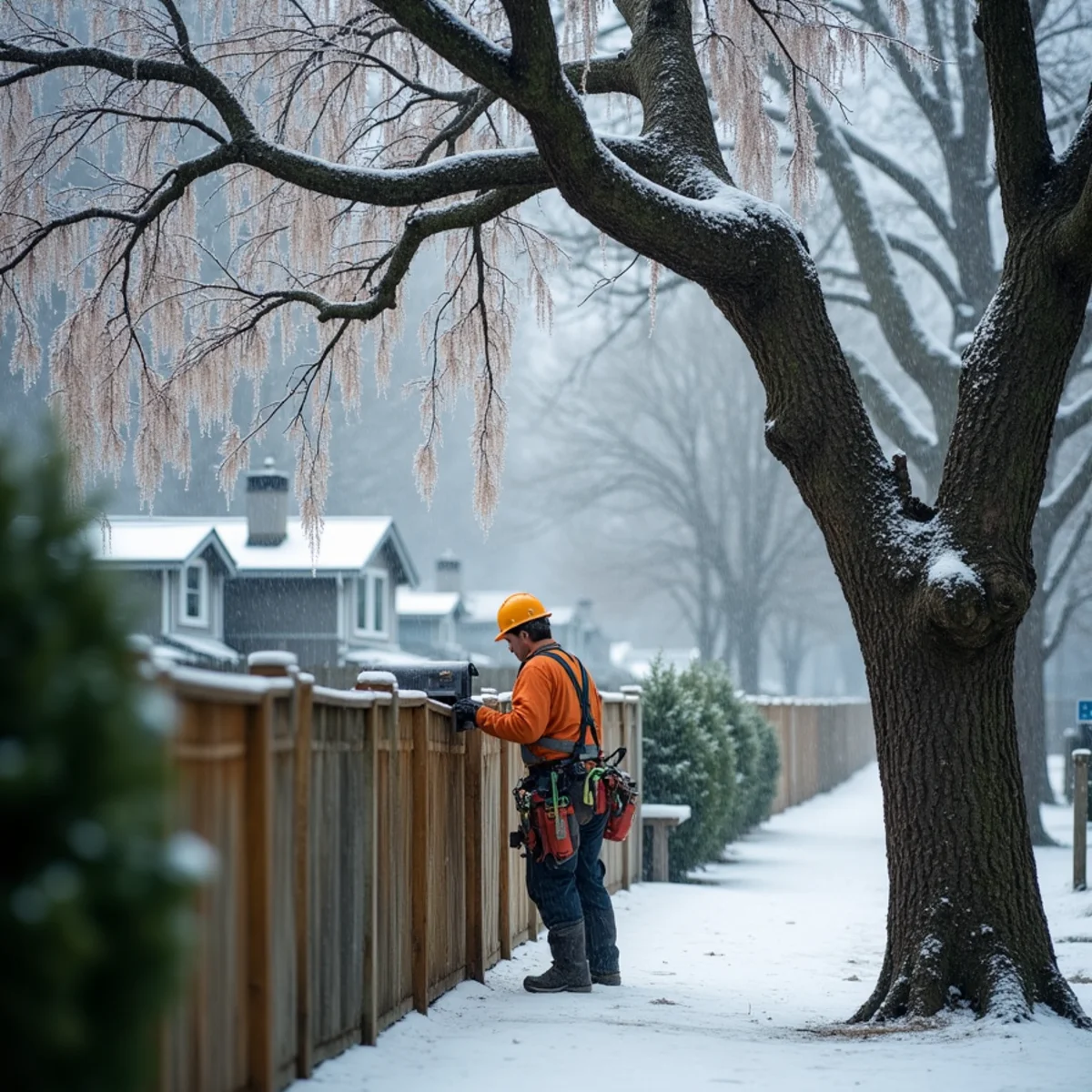
The rain that worries us here does not sound like rain. It ticks. A homeowner near Lacamas Lake called one January morning, and daylight showed her an arborvitae screen folded flat across the driveway, every stem glazed and bent like wet rope. Downriver in Longview, the same storm had been a plain gray night.
That gap is not luck of the draw. The west mouth of the Columbia Gorge runs its own winter, and Camas sits in the doorway. Worth understanding, because it tells you which trees on your place are exposed.
Why the Gorge Mouth Glazes While Longview Only Gets Wet
East of the Cascades, winter stacks up a pool of cold, dense continental air over the Columbia Basin. Air that cold does not climb mountains. It looks for a hole, and the Gorge is the only sea-level cut through the range. When pressure runs higher inland than on the coast, that air drains west and spills out at Camas and Washougal.
A Pacific front arrives from the other direction at the same time with milder, wetter air. It rides up over the cold layer instead of mixing in. Rain forms warm aloft, falls as liquid, then passes through the freezing air near the ground and turns to glass. The old name for it is silver thaw.
Move west and that cold tongue thins out, which is why the storm that shuts down Washougal leaves the lower Cowlitz valley merely rainy. The same pressure difference drives the east wind, so ice and wind arrive together, from one direction.
Ice Plus East Wind Is Not the Same as Ice Alone
Ice on a still night is a vertical load. Branches sag, some snap, and the tree sheds weight by bending. Add a steady east wind and two things change. Frozen twigs stop flexing, so the crown behaves less like a flag and more like a billboard. And the load quits being vertical.
That is why the damage is so lopsided. Walk Prune Hill the morning after and the failures point the same way: split unions on the east face, hedges laid over toward the house.
Which Trees Fail First Here
It is rarely the biggest tree in the yard. It is the one carrying the most surface area for its wood strength, on attachments that were already weak.
- Broadleaf evergreens. Laurel, holly, rhododendron and photinia hold full foliage in January, collecting ice across every leaf instead of on bare twigs. Sheared laurel hedges are the worst — the outer shell catches everything while the interior stems stay thin.
- Arborvitae and Leyland cypress screens. The most common ice casualty on the east side of Clark County. Several upright stems from near the ground, joined in tight unions with bark pinched inside instead of wood, all carrying dense foliage. Loaded and pushed, they splay and stay that way.
- Overextended bigleaf maple. Maple runs long, nearly horizontal limbs over driveways and rooflines, and the wood is not strong for its size. Add the codominant unions with included bark it makes constantly and you have real leverage held on by a seam.
- Anything that was topped. Topping forces a flush of sprouts anchored only in the outer wood around the wound. Ten years on they are limb-sized and still attached like siding. Iced and wind-loaded, they tear out in slabs.
- Newly exposed edge trees. A fir that grew up inside a stand and now stands alone because the neighbor cleared his lot has never carried a full wind load, iced or otherwise.
Where a tree has already dropped a leader, or leans over the house on a union that has opened, pruning is not the fix. That is a conversation about hazard tree removal, better had in October than in the dark with a tarp on the roof.
Pre-Season Pruning That Actually Reduces Failure
Some pruning measurably lowers the odds of a limb coming off. Plenty of what gets sold as storm-proofing does the opposite. The difference is whether the work reduces leverage or only removes foliage.
- End-weight reduction. Shortening the outer portion of a long horizontal limb back to a suitable lateral cuts the lever arm and the ice-collecting surface, while leaving interior growth that lets it flex.
- Deadwood removal. Dead limbs have no flex left. They break first, and they are the likeliest thing to come through a skylight.
- Codominant unions. Where two near-equal stems meet in a tight V with included bark, the options are subordinating one stem over several seasons, cabling, or taking the weaker stem off.
- Reducing sheared evergreen screens instead of shearing them again. Every pass thickens the outer shell that catches ice. Selective reduction into the interior opens that wall so it sheds.
None of that is exotic. It is ordinary structural pruning and crown reduction done with the loading in mind, scheduled in early fall while there is room on the calendar.
What Does Not Help
- Topping. It buys one season and leaves a permanently weaker tree with a decay column at every cut.
- Lion's tailing — stripping the interior and leaving a puff of foliage at the tips. Looks tidy, and concentrates the remaining weight at the far end of the lever.
- Blanket thinning of conifers. Douglas fir and western red cedar handle ice reasonably well, and heavy thinning mostly costs the tree energy.
- Waiting for the forecast to mention freezing rain. Working an iced tree is dangerous, and every crew is booked the hour it starts.
When Something Breaks Anyway
These events end the same way: a still gray morning, a yard full of debris, and limbs hung up in the canopy that came down halfway and stopped. Those hangers are the real danger after the storm rather than during it — they release with no warning and no wind. Keep people and vehicles out from under them until a crew with ropes can bring them down. That is what our emergency storm damage tree service is for, and storm emergencies are answered outside business hours.
Photograph everything from a safe distance before anything is cut. Once the limbs are chipped, the evidence of how the failure happened is gone, and that is what an adjuster will ask about. This is general information; your policy, insurer and attorney govern your claim.
Get It Looked At Before the East Wind Does
Trees that fail in a Gorge ice event almost always showed something first. A seam opening in a union. A maple limb reaching too far over the roof. A hedge still leaning from last winter. Fall is when that gets handled on your schedule, not at six in the morning with water coming through the ceiling. Ryan walks every estimate himself, the on-site estimate is free, and he will tell you straight when a tree needs nothing done. Call us at (208) 635-2100.